Order a Reading

Friday, 10 October 2014

Full Moon in Aries Emperor Reading


                               1. How am I an Emperor?
                               2. How am I not an Emperor?
                               3. Where do I need to take charge?
                               4. What will help me do that?
                               5. How am I weak?
                               6. How am I strong?

I really don't think I like this reading at all--and it is those uncomfortable readings that we need to pay most attention to. This one has brought up some of my shadow aspects, things about myself I don't like to look at.

Sunday, 5 October 2014

Share a Spread Sunday - Full Moon in Aries

Full Moon in Aries
8 October 2014

This week the full moon is in Aries, which is associated with the Emperor. I thought it would be fun to look at a 'wisdom reading' from Rachel Pollack's 'Tarot Wisdom'.

First of all, the Emperor, according to Rachel, can be interpreted four ways:

1. The laws of society
2. Divine law
3. Daddy
4. Zeus and other kings of the gods

These are pretty standard interpretations, nothing earth-shattering there. The Emperor can be rules, authority, hierarchy, power; the abstract principles of universal laws (such as physics) and/or Creator God; the masculine principle or father figures; or a king of the gods from any pantheon.

So are you feeling manly this week or what? In what ways might you need to take command of a situation, take a leadership role, or act with intent and purpose?

In fact, you could use the questions above for your Full Moon Spread, but I'm going to use the questions from Rachel Pollack's book, and they include a 'wisdom reading'. These are questions that go beyond the personal. These are audacious questions that boldly ask for very BIG answers, questions like 'What is love?' 'What is the meaning of Time?' or 'Who is God?'

This is Rachel's 'personal spread' based on the Emperor: 

1. How am I an Emperor?
2. How am I not an Emperor?
3. Where do I need to take charge?
4. What will help me do that?
5. How am I weak?
6. How am I strong?

But then as a last question, she throws in one that is really a 'wisdom reading':

7. What are the rules? 

Do you dare to do a draw on that question? I am going to be looking at both spreads this week.

Saturday, 4 October 2014

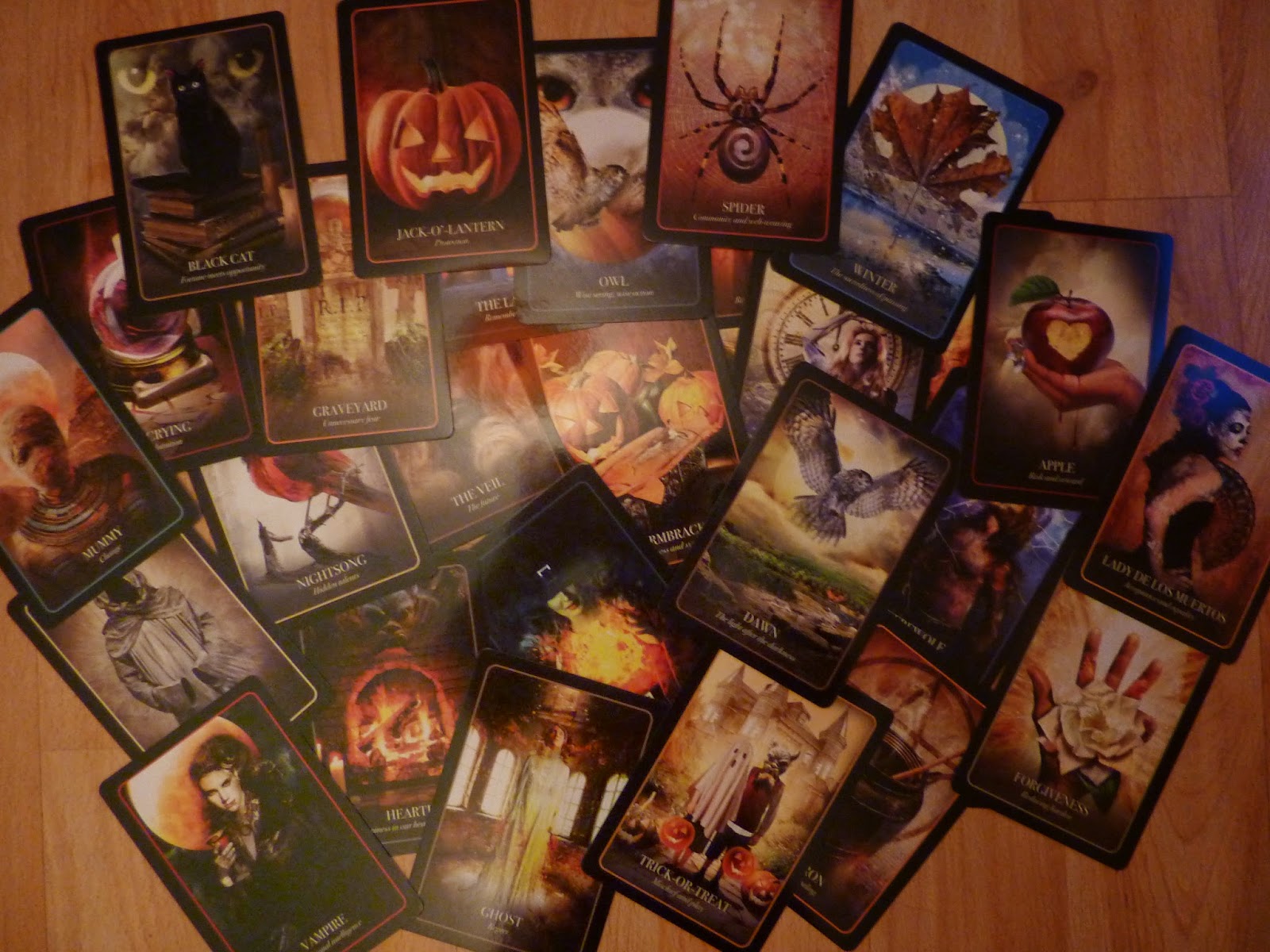
Deck Review - Halloween Oracle


Halloween Oracle by Stacey Demarco and Jimmy Manton 
(Blue Angel 2014)

I'm growing quite fond of oracles by Blue Angel Publishing. For one thing, they come in a standard size box of sturdy construction and the cards are of consistent style and quality. I like that. I like the way a line of Blue Angel boxes looks lined up on the shelf. We've all got our kinks. 

What's included
Attractive standard size Blue Angel oracle box, black on the outside with orange on the inside, a 36 card oracle deck and an 80 page companion book that fits inside the box. As usual, the cards are smaller than the box and a liner to make them fit is not included. The book fits over the cards and sits snugly inside the box. I was surprised that the deck is only 36 cards as Blue Angel usually includes 44 cards, and goodness knows there is plenty of Halloween material to come up with more than 44 cards! A curious decision.


Friday, 3 October 2014

This ain't the Love Boat, Captain!

Looks, it's the Knave of Knives, or Page of Swords, from Robert Place's Vampire Tarot. She's called the Nightmare of Life in Death, and she comes from Samuel Taylor Coleridge's poem, 'Rime of the Ancient Mariner,' first published in 1798 in Coleridge's pivotal collection 'Lyrical Ballads.' It only ushered in the Romantic Period! It's from this poem that the phrase 'albatross around my neck' originated. But it also happens to be the very first appearance in English literature of a vampire. (The first vampire in English prose was Lord Ruthven. Nightmare Life in Death came earlier.)

You probably read 'Rime of the Ancient Mariner' in high school, unless you went to a state school in the UK after GCSEs came in, in which case you probably only read Simon Armitage and whatever other bits and bobs were in your AQA handbook. (I'm no fan of the  methods and curriculum of English teaching in the UK, which is why I quit.) If you're American (or went to a grammar school), you may have vague memories of reading a LONG, sing-song poem with the words 'Water, water everywhere nor any a drop to drink.' That's the one.


Wednesday, 1 October 2014

Lesbian Vampire Killers of 1871

The Page of Cups, or Knave of Holy Water,  from Vampire Tarot by Robert Place, is represented by the fictional character Carmilla, from the novella of the same name by Joseph Sheridan Le Fanu. Published in 1871 and inspired by Samuel Taylor Coleridge's poem 'Christabel', the novella introduces the first lesbian vampire. So! All those 60s and 70s horror flicks like 'Vampires' (1974) , Lust for a Vampire (1971) and Blood and Roses (1960) were not just sleazy exploitation films -- they come from a long tradition of lesbian vampires, a tradition that predates the creation of Dracula (which didn't appear until 1897). In fact, the first screen lesbian vampire appeared in 1936 in a film called 'Dracula's Daughter', and Carmilla herself appears for the first time on the silver screen in the above-mentioned movie 'Blood and Roses'.

The 1871 novella 'Carmilla' concerns itself with the (seemingly) 19-year-old young woman called Carmilla who is taken into the home of narrator Laura, after Carmilla is involved in a carriage crash just outside Laura's home. Carmilla's mother says she is on urgent business and cannot delay, and Laura's father agrees, after Laura's urging,  to allow Carmilla to convalesce in their home.  Bad plan. Find a full plot summary here: Carmilla Plot Summary. And if you want to go all out and read the whole thing, it is online here:  Carmilla by Joseph Sheridan Le Fanu. If you don't have time for either, allow me: Carmilla and Laura become constant companions. Laura finds Carmilla both beautiful and repulsive. Laura has disturbing dreams. She and Carmilla do quite a bit of kanoodling (as much as 19th century literary sensibilities would allow), though not always willingly on Laura's part. Laura discovers a portrait of one of her own ancestors, Mircalla of Karnstein, painted in 1698, who looks exactly like Carmilla. Carmilla begins to bloom with health while Laura fades. A family friend, General Spielsdorf, tells a tale of how his own niece had had a friend called Millarca who bloomed while the niece faded, and finally died from it. He had seen Millarca draining the niece of her last drop of life blood. The General and Carmilla recognise each other and fight. She wins and runs away. Then Baron Vordenberg, vampire killer, turns up, they hunt Carmilla in her lair and drive a stake through her heart. The End.

Now, how that can be the Page of Cups is up to Robert Place to explain. He writes, 'The card represents someone or something that is alluring and magically influential but that may not be what he or she seems.' Not very Page of Cupsy, but we'll go with that.