Order a Reading

Monday, 7 July 2014

Sacred India Tarot: Shiva and Parvati

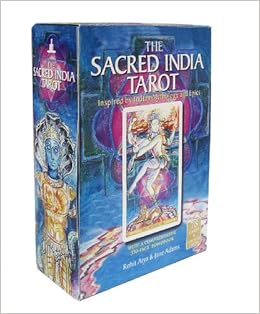
The Sacred India Tarot by Rohit Arya (illustrated by Jane Adams) is based on Indian mythology and epics and was published 2011 by Yogi Impressions. In this deck, the minor suits tell a complete story. Discs (Pentacles) tells the story of the life of Buddha. Lotuses (Cups) tells the story of the courtship of Shiva and Parvati. Staves (Wands) is the legend of Rama. And Arrows (Swords) is the story of the battle of Mahabharata. I'd like to take a look at each of these over the course of the week. Because the story of Buddha is so familiar to me, I'm going to start with the courtship of Shiva and Parvati (the suit of Cups or Lotuses).

Lord Shiva was married to Sati, but Sati's father insulted Shiva  (even gods have silly domestic squabbles) and so Sati decided the honorable thing to do would be to kill herself (gods and goddesses tend to do extravagant things like that). So she does. Shiva takes this hard and retreats to a cave and immerses himself in intense meditation. This probably wouldn't have been a problem to the other gods, except a pesky demon called Tarakasura is causing them a lot of trouble and they need Shiva to get off his butt and help. As that wasn't happening, they asked Brahma what to do. Brahma passes on the helpful information that only a son of Shiva can defeat Tarakasura. The gods are distressed because Shiva is a widower and might not ever get over it! They go to Mahadevi and ask her for advice. She confirms that only a child of Shiva can defeat Tarakasura, but takes pity on them and promises to incarnate herself as a wife for Shiva. (This is handy, because it turns out Sati had been an emanation  of Mahadevi anyway. So this incarnation will be a reincarnation of Sati.)

So Parvati is born to the Lord of the Mountains. She has tremendous devotion to Shiva from a young age and knows in her heart she can marry only him. (Kind of like I was about John Taylor of Duran Duran, I guess). Her parents aren't sure what to make of this and try to convince her to marry someone more accessible, but then a devarishi, Narada, confirms that Parvati is destined to marry Shiva and give birth to his son.

Parvati's father offers Parvati to the deeply meditating Shiva as an attendant to take care of him as he meditates. Shiva is so deep in meditation he can't tell male from female anymore and doesn't mind one way or another, so agrees.

Well, the gods are running out of patience and know this subtle courtship could take eternity, so they send Kamadeva (sort of like the Hindu Cupid) to shoot his arrow into Shiva, which he does. Shiva is startled, notices Parvati and is kinda turned on by her. But he feels bad about being unfaithful to the memory of Sati and turns his attention to Kamadeva, opens his third eye and burns Kama up for disturbing him. Oops. Kama's wife is distressed and faints, Parvati is upset and humiliated and she retreats from Shiva's presence.

Parvati realises she must become worthy of Shiva and win his love herself, so she goes off and becomes an ascetic. She meditates night and day, stops requiring food, then water, and eventually air. The other devas like to come round to have a look at her. She's acquiring great heights of enlightenment and such. She becomes known as The Lady of the Unbroken Fast and eventually even the gods come round for a blessing from her. But Parvati is also Mother of the World and a lover of trees, and she would break her meditation every day to go and care for the trees and feed the deer. She understands that meditation and enlightenment are no good without continuing involvement in real life.

Eventually even uber-meditator Shiva hears about Parvati and knows that she is doing all this because of her amazing love and desire for him, so he goes to her -- in disguise of course, because she needs to be tested! He asks her what she's doing this for, and she replies that she wants to marry Shiva. Shiva,in disguise,mocks her and insults Shiva (himself), which causes Parvati to become angry and she upbraids him. Shiva is besotten. (Rolls eyes).

And so at last, Shiva and Parvati are married. (They have been married many times before in many lifetimes -- these two are always together.) Shiva and Parvati merge into a new aspect of divinity that is simultaneously male, female and deity. In due time, Skanda is born to them, and he defeats Tarakasura, as he was meant to. (And Shiva allows Kamadeva to come back to life.)

Here are few of the cards -- can you figure out which parts of the story are being depicted?


(Left to right: Shiva incinerates Kama; Parvati bows at feet of Narada when he announces she will marry Shiva; Parvati tends to the trees; Shiva - in disguise - tests the ascetic Parvati)

I will draw from this suit tomorrow. :)

Saturday, 5 July 2014

The Knight of Pentacles is a Cognitive Behaviour Therapist

Sirian Starseed 
I bought a yoga journal yesterday, DailyGreatness Yoga Journal: Your Masterplan for a Beautifully Conscious Life.  It's a lovely book and can be a great tool for developing good habits. I hesitated about purchasing it because of 1) the price tag and 2) my tendencies to become OCD about this sort of thing. A book like this panders to the colour-coded list maker type, which I certainly am. It's the follow-through where I trip up, and in the last few months of working with Cognitive Behaviour techniques, I'm beginning to understand why.

I might as well just tell you about the type of CBT I've been exploring. It's called Rational Emotive Behaviour Therapy, and it's very illuminating.

According to REBT, we disturb ourselves by making three irrational demands of life. We are not aware that we hold these demands, but they are the usual underlying cause of disturbance:

1. The demand that we perform well or outstandingly at all times.
2. The demand for others to treat us nicely, considerately or fairly at all times.
3. The demand for life to be comfortable and hassle-free at all times.

(These are irrational demands, obviously, but think about it. You can probably trace most of your unsettledness, unhappiness, anger, anxiety, depression, etc, back to one or all of these three. I have no idea why we do this.)

This style of cognitive behaviour therapy does not seek to put a positive spin on everything that happens to you or on how you feel, but to help you understand that by taking the demand out of your thinking and increasing your frustration tolerance to experiences you don't like, you can develop confidence and increase your chance of success.

Some of us seem to have these coping skills naturally, others of us need to develop them. For some of us, to greater or lesser degrees, when the above unconscious demands are not met, we tend to have one or all of the following three reactions:

1. 'Awfulizing' - the event is not just bad, it is the worst thing that has ever happened in the history of the universe and there is nothing that could be worse. We say things like - It is a disaster. It is the end of the world. It is a catastophe. It is horrible/awful/terrible.

2. Low Frustration Tolerance (LFT) - a belief that underestimates your ability to cope. We say things like - It is intolerable. I can't take this. I cannot stand this. It is too hard.

3. Self-damning - judging yourself in a globally dismissive, totally negative way. We say things like - I am a loser. I am a failure. I am weak. I am stupid. I am worthless. I am useless. I am an idiot.

REBT offers three strategies to counter the above reactions:

1. Reality check - Is it a natural law, like gravity? Is there any evidence to support it, as in the kind of evidence that supports the existence of gravity?

2. Common sense - Is it logical to state this?

3. Helpful - Is this belief helpful to the situation?

Then we can turn the beliefs around to modified statements, statements that do not deny the reality that what you are going through is not fun for you (I appreciate that):

'It would be bad if --------but it is not the end of the world.'

'It would be very difficult if ----------but I can live through it. It will not kill me.'

'I don't like the fact that --------- but that does not make me a failure as a human being. I remain worthwhile and fallible.'

So...there are these blank pages in the yoga journal that ask me to write all this stuff down, make a mission statement, make a 90-day forward plan. I looked at the pages and I started to get a bit freaked out. Why? Because of my demand on myself to perform outstandingly at all times. I must fill the pages in perfectly, or I cannot fill them in at all. Why?

Because If I don't fill these pages out perfectly, it would be a disaster. I would ruin the book. I would have wasted my money. It would be the worst thing that could possible happen! And if I mess up the book, if I don't get it right, I couldn't cope with that. The guilt of buying such a nice book and not being able to use it properly would make me feel terrible. I couldn't cope with that. And isn't this just the way I always end up - I fail at everything, because I am useless and stupid and I can't do anything right. I might as well just forget the whole thing because I will surely not use it properly for the year anyway.

Because filling out this book should be easy. It's something I want to do, so it should be easy. If it isn't easy, that would be horrible! I cannot cope with things that are not easy. I cannot deal with them. If it isn't easy for me, it means I am too stupid to do it and shouldn't have even bought the book.

Now -- do you see how that thinking went straight through the REBT pattern???? And do you see how it can come about that a person would buy a journal and then be afraid to write in it?

You know, you don't sit and literally think all these things. They are like flashes and pangs of emotion, not verbalised. And it can all flash through you in a matter of seconds.

But, wait.

There is no truth in the belief that I would ruin the book and have wasted my money if I don't get it perfect. There is no law that says a book must be filled in perfectly. Also, it is true that I may feel bad about not filling in the book perfectly, but it is not true that I cannot cope with that. I can bear it. I will not break, fall apart or die -- it is nonsensical to feel that disaster will befall me if I do not fill in the book perfectly. Also, if I don't know what to write in the journal, it makes no sense to conclude that I therefore know nothing and that I am useless, stupid and a failure. The truth of the matter is, I simply don't know what to write. It is not helpful to hold the beliefs that the book must be perfect, that I cannot bear it if I don't write the 'right' thing, and that I am a failure - these beliefs create the anxiety that prevents me from taking any action at all.

And there is no truth in the belief that filling in the book should be easy. There is no evidence that life has to be easy and comfortable. There is no universal law saying that filling in a book should be easy. It is perfectly reasonable to want things to be easy, however it does not follow that just because you wish it, it should be so. It is common sense to accept the fact that while I may want something to be so -- in this case, goal-setting should be easy -- that doesn't mean it has to be so. (Just because we want it to be a sunny day doesn't mean the sun must shine, does it?)  The belief that goal-setting should be easy is unhelpful. The demand provokes anxiety and leads to avoidance behaviour.

And so I can set healthier beliefs:

I want to fill in the new journal perfectly, but I don't have to. The fact that I may not fill it in perfectly is uncomfortable for me, but not the worst thing that could ever happen to me. It is frustrating, but I can bear it. I will not die.  It doesn't make me useless. It doesn't make me a failure. It doesn't mean that the rest of the book would then be ruined. I accept myself as a fallible person, and my worth does not depend on how I fill in the book.

These truer statements can also flash through you in a matter of seconds...but you will probably have to start challenging beliefs after the fact before you reach the point where you can do it automatically. (Unless, like some lucky people, you were born with or were taught the skill by the way you were raised).

I cannot tell you what a struggle it has been to make myself start writing in this book. The desire to avoid writing in it in order to avoid all the feelings and fears about it is very strong.

This morning I drew Adept of Crystals -- Knight of Pentacles. 'Take your time,' he said. 'Do things slowly. Work it out.'


Friday, 4 July 2014

Karma Karma Karma Karma...

'Every thought you produce, anything you say, any action you do, it bears your signature.'
 ~ Thich Nhat Hanh

You know what? Karma doesn't means 'what goes around comes around.' That is a gross oversimplification. Karma is not about universal paybacks. Karma is not reward for good and punishment for bad.

'Karma' simply means 'action' or 'deed'. A man who performs good actions is a good man. A man who performs evil actions is an evil man. 'Anything you do, it bears your signature,' Thich Nhat Hanh says. Maya Angelou said it this way: 'When people show you who they are, believe them.' That is what karma means. You are what you do. You are your actions. You cannot do evil and say, 'I am really a good person though, so this doesn't count. I cannot be judged based on my actions but on my inherent worth as a human being.' It doesn't work that way. What else are you besides what you do? 'My actions are my only true belongings,' says Thich Nhat Hanh, 'I cannot escape the consequences of my actions. My actions are the ground upon which I stand.'

Now as a man is like this or like that, according as he acts and according as he behaves, so will he be; a man of good acts will become good, a man of bad acts, bad; he becomes pure by pure deeds, bad by bad deeds;
And here they say that a person consists of desires, and as is his desire, so is his will; and as is his will, so is his deed; and whatever deed he does, that he will reap.
                                                                        —Brihadaranyaka Upanishad, 7th Century BC

In a talk, someone asked Thich Nhat Hanh about karma:
You never speak of karma. Why not?

'I speak of karma all the time. There is no moment when I do not speak on karma. Karma means action. The action can be in the form of a thought, or in the form of a word, or it can be in the form of a physical action. So when I speak about mindful breathing, that is good karma. Mindful breathing is good action to bring your body and mind together, so you can be there in order to touch life deeply. When I speak about the Five Mindfulness Trainings, I speak about karma, because karma is action—if you think, if you speak, according to the spirit of the Five Mindfulness Trainings, you will get good results: peace, joy and happiness will be yours. I do not use the word karma, the technical term, but I always speak of karma, and the food of karma, which is karmaphala. And also good karma and negative karma. Let us not be caught by terms, even ideas. Let us deal with our actual problems. Let us have real practice, and not indulge ourselves in too much speculation and too many ideas.'

So let's dispense of all this talk about pay backs through karma. Any pay backs in karma come only from within ourselves, and happen to ourselves. That is what 'Whatever deed he does, that will he reap' actually means. 

And what does this have to do with today's card? Even though the LWB speaks a bit in 'payback' language -- 'a time of reckoning' -- the spirit of karma as I understand it (as taught by Thich Nhat Hanh and the Birhadarankya Upanishad) is the same:

Do I walk my talk?
Have I learned how I have created everything in my world?
What lessons are to be learned? Have I learned them?
Am I ready for transformational epiphany?

Today is Independence Day. Free your mind from the pay back mentality of karma and look to your own actions. Your actions are the ground upon which you stand.

Thursday, 3 July 2014

Gather your thoughts - 4 of Orbs in Sirian Starseed

I love this image from the Sirian Starseed Tarot. It's such a lovely evocation of what it's like to be in meditation. There are moments, fleeting, between listening to sounds, between wondering if you're doing it right, between resisting the urge to peek at the clock, between hoping your feet don't go to sleep so deeply that you fall down when you try to stand up--there are moments when you really do disappear into yourself, and join the wash of the waves of the universe and feel a kind of alignment through the spine with the heavens above and the earth below.

This is so much more powerful to me than a medieval tomb in a relic of a cathedral.

The card tells me today is a day for quiet introspection, hibernation, meditation. It is not a day for solving problems. It is a day for retreat, for gathering oneself in, for recharging in preparation for dealing with the problems. The problems will wait. They always do.

Wednesday, 2 July 2014

'You canNOT be Sirius' -- the Dog Star in Sirian Starseed


Osiris
I've drawn the Star from Sirian Starseed this morning. This card features, of course, Sirius, the Dog Star, the brightest star in the sky. It is the nearest star to earth at 8.6 light years' distance. It is nearly twice as hot as the sun and puts out 26 times more energy, which it produces by converting hydrogen to helium through nuclear fusion. This is Sirius A.

Sirius B is 10,000 times dimmer than Sirius A and wasn't discovered until 1862. A white dwarf companion to Sirius A, it is very small at nearly the diameter of earth, and is affectionately called 'The Pup.'

As far as Sirius C is concerned, there is debate in the scientific community as to its existence. If it exists, it is tiny. It was first suspected in 1894 because of anomalies in the Sirius orbit. Something was observed at least 20 times between 1920 and 1930, but even scientists were unsure if they were actually seeing anything. A study of 60 years of observation conducted in 1978 by Gatewood & Gatewood concluded that nothing suggests the existence of a third body. However, there are anomalies and the debate continues.

Well -- of course you know a big bright obvious star, a tiny companion, and a near-mythic teeny-tiny 'phantom' star would hold GREAT appeal to New Age types! Listen to this from the LWB:
The image [on the card] includes the three stars of the triunal Sirian star system, described in detail in Sirian Revelations [a series of three books by guess who -- deck creator Patricia Cori] as Sirius A (still in the third dimension, Sirius B (ascended to the sixth dimension) and Sirius C (ascended to the fourth dimension). The Egyptians referred to them as the 'star sisters' and indeed they are. Hence, it also invites us to contemplate the ascension process, which many of us know we have come into this lifetime to experience. 
Click here for some 'channeled material' from the Sirians on Patricia Cori's website. (While you're there, click the link to the messages from the Sirian High Council. I like how they all end with ©Patricia Cori! Ha ha). And here is an entertaining look at some of the New Age ideas surrounding the Dog Star: The Dog Star from Outer Space.

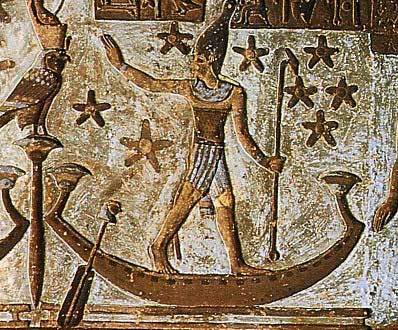
So in the card we have Osiris, riding a barge through the heavens, holding a staff and an ankh. Sirius tops his staff. I assume the big star over his ankh is meant to be Sirius B. And your guess is as good as mine as to which little blinky is meant to be Sirius C. The interpretation is traditional - hope, trust, moving toward dreams or goals, etc.

Today I go to the surgeon to have my hearing checked again. The card suggests a positive outcome. For me, that will mean my hearing hasn't decreased more than expected and that I'm holding steady.