Order a Reading

Showing posts with label Haindl Tarot. Show all posts

Friday, 12 June 2015

My trimmed Haindl is clean again

^^4 of Stones before cleaning...
A few years ago I bought a jumbo Haindl and trimmed it. Then for some unknown reason I decided to write key phrases on the cards. It didn't work out as I'd hoped and so into the box the deck went and hasn't seen the light of day for many a moon.

Today I tried using surgical spirit and cotton wool to wipe the writing off -- and it worked! So I'm pleased to say, the Haindl Tarot will be back in action!

This post is for Kelly at The Truth in the Story. It was her You Tube about the Haindl that inspired me to get mine out. Watch it here: First Impressions - Haindl Tarot .


So Kelly, here are the trimmed Haindl cards, thrown out across the floor. I really like this deck borderless! ---
Trimmed jumbo Haindl -- freshly cleaned of handwritten key phrases!


And this will give you an idea of the size--

Playing card, yellow box Rider, trimmed jumbo Haindl 

Friday, 14 June 2013

'You have chosen wisely'

Haindl Tarot, Lotos 2002
I found something I wrote about the Haindl Tarot last year ( What's it all about?) in which I try to explain the tone and mood of this deck, as it seems to me. I don't think any card in the deck captures the mood of this deck as well as Parzival, the Prince of Cups.

Parzival (or Parsifal) also appears in the Fool card in the Haindl Tarot, which depicts the scene where Parsifal kills the swan, an impetuous action which caused him to discover sin, death, and responsibility. The Prince of Cups ( 'Son of Cups in the North', as it is called in Haindl Tarot) depicts the moment when Parsifal achieves the Grail. His face is lit up by its radiance, his expression shows he is overwhelmed and in shock. He's melting away, look at his hands, and how his image seems to liquify and smear right off the card.

Rachel Pollack says this is a complicated moment. 'On one side it signifies the discovery of spiritual truth, something greater and deeper than personal desire. Parsifal becomes aware of the Holy Spirit and Divine Truth. This challenges him to goals beyond his own gratification...' Pollack goes on to suggest that Parsifal sees in the Grail the wounded earth, and our need to restore it. This wounded earth theme pervades the Haindl Tarot, as does the 'shock-and-awe' of enlightenment, so I think the Prince of Cups is the quintessential Haindl card.

Once all the high-flown stuff is out of the way, in a real drawing, the card is usually interpreted a lot like any Prince (or Page) of Cups: someone who is sweet-tempered, naive, easily moved. Possibly self-centered but only due to his naivety. When it's pointed out to him how he's aggrieved someone, he feels genuinely sorry (like Parsifal and the swan). He's just a gentle, tender-hearted kid, really.

Thursday, 13 June 2013

Only her hairdresser knows for sure

I'm an Aquarius and so it seems natural that the Star is a favourite card of mine, and this one from Haindl Tarot (Lotos 2002) is in my Top Ten of all Star cards. There's something so romantic about the maiden washing her hair in the stream here. I love it. It has to do with oneness, and vulnerability, and purity, and ritual, and all sorts of wonderful things.

'The Star shows a kind of consciousness that does not need  extreme measures. She bends down to wash her hair, and so becomes part of stone and water. With the star in the sky giving us fire and air, we find all four elements, not as in the mystic Grail emblems of the Magician, but in nature, in daily life' (Pollack, Haindl Tarot: Major Arcana).

I like the easy nature of the card, and as I don't have to go to work today (it's my day off for Saturday), I hope my day is as flowing and gentle as this card. I'm off to Spec Savers, though, to see if they can do anything about this nuisance of having to take my glasses off every time I need to something close up, and put them on again to see something across the room. My days of reading while watching TV are now in the past! And at this point, even my dinner looks blurry if I don't take my glasses off. They may give me a new prescription, but I bet they just tell me to keep taking them off and putting them on to deal with the close vs distance vision thing. Ah, aging.

Added to this card we see the Hebrew letter Tzaddi, meaning 'fishhook', the rune Eh, which means 'horse', and the astrological symbol for Aquarius. This card is associated with element Air, which is symbolized by the white border. (I forgot to mention border colours in previous posts.) To be honest, I have no clue what fishhooks and horses have to do with this card, but there you go!


Wednesday, 12 June 2013

Roots and rocks

What says 'earth' to you more than anything else? On a really basic level, I mean. Sticks and stones? Roots and rocks? That's what we have here in the Four of Stones from the Haindl Tarot (Lotos 2002). I don't know about you, but I see the base of a tree, its roots partially exposed, and two broad wisps of brownish mist hovering around it, with four round stones floating in front, as they are strangely wont to do in this deck.

The RWS deck of course has Four of Pentacles meaning someone being miserly or self-protective, showing a person hugging a giant coin, more under each foot, with one usually balanced on their head. Here we've got none of that, just rocks and roots. And the name of this card is 'The Power of the Earth'. That has a wonderful ring to it, don't you think?

The Four of Disks in the Thoth deck also seems to hold a feeling of protectiveness. Crowley likens the image to a fortress. He then goes on to talk about Sol in Capricornus, and various translations of the words 'queen' and 'castle', ending his comments on the Four of Disks by noting the guttural sounds of Hebrew, so...not much help from Uncle Al in his Book of Thoth.

I am not sure why each stone is a different colour (blue, red, white, yellow), but Pollack suggests it has to do with the cardinal directions (though she actually says it's the tree roots that are colours, but that must be just an editorial mishap.)

No, for me the meaning of this card comes from the combination of the image and the title. 'The Power of the    Earth', and the tree roots, and now that I look at possibly water around the roots, and the rocks, and the mist. The earth is filled with mysteries and mundanities.

For a reading, I would be most likely to fall back on numerology and suit:  the stolid nature of the four, the material/physical energy of the suit. Heavy rocks, gripping tree roots, I can see how these could link back to the fortress and protection themes of the Thoth and RWS. But I would see this coming from a much deeper and, dare I say it, 'grounded' place than either RWS or Thoth. This is an assurance that comes from the very foundations.

Tuesday, 11 June 2013

Stones and stripes

This card from Haindl Tarot (Lotos 2002) always makes me think of striped pyjamas, which makes me think of 'The Boy in the Striped Pyjamas', which makes me think of World War II and prisoners in concentration camps. It's awful, I know, but it's what I thought of the first time I saw the card. I later found out that the deck creator, Hermann Haindl, did spend time in a Russian prisoner of war camp. I have no idea why I've always thought of these things, but I'm pretty sure Haindl probably had no such thing in mind when he created this card. Rachel Pollack's guidebook explains that actually this image comes from a detail of a painting by Haindl of the Greek God Dionysus, 'from a section of the painting meant to indicate harmony.' She goes on to explain that the pattern seen here is like the lines of a tallis, or prayer shawl worn by Jewish men. So there's some sort of connection going on in there...

Anyway, leaving aside my odd associations, this certainly appears to be a card about balance. The two stones are balanced, the dark and light stripes balance one another, and there's a dark area in on the lower right side of the card contrasting with a bright area onthe upper left side of the card. These things remind me more of the juggling man in the RWS 2 of Pentacles than of the Golden Dawn title, 'Harmonious Change'. But I guess when you think about it, for a change to be harmonious, all its elements would need to be in balance. It's lack of balance that causes conflict, or disharmony, so actually it does make sense.

Actually, balance has been a lot on my mind this morning, so this card is a good one to draw today. Pollack says this card can represent working together harmoniously, especially in business. I would add that because this is the pentacles/coins/disk suit, it also has to do with aspects of physical health, and it's in that area that I'm seeking some 'harmonious change'. 

Monday, 10 June 2013

Enter the dragon

Haindl, Lotos 2002
Another major today! This is the World card, or 'The Universe', from the Haindl Tarot (Lotos 2002). It's certainly nothing like the World card familiar to us through older decks such as RWS, TdM, or even Thoth. The first thing you notice on this card is this big fire-breathing worm or firedrake, a very romantic-sounding word, and one I prefer to the word 'dragon'. Don't you love the word 'firedrake'?

Anyway, this firedrake is flying through outerspace, and he's a big old boy, because you can see that his body and tail actually encircle the earth (the end of his tail curls around the globe and is coming round from the left side of the card, see it?) Who is this serpent and what could he mean? Because he sure doesn't remind me at all of the Christ-in-glory imagery of the traditional World cards:


Click for image source

Nor is he like the Thoth Universe card, on which this card is presumably based, though at least there's a snake in that card. In Haindl's Universe card, the firedrake seems to be based on the World Serpent of Germanic myth, who has grown so large that he encircles the earth and grasps his own tail. When he lets go of his tail, the world will end. We can see in Haindl's card that the serpent has let go of his tail, so what does that mean? Is this a card of the end of the world? In a way, yes, because the Universe card is a card of transcendence, and releasing his tail allows the firedrake to fly off into the vastness of space and have a look around, just as enlightenment for us means a greater connection to whatever is beyond our current experience and understanding. However, I have no doubts that the dragon will come back to the earth. As Rachel Pollack says in Haindl Tarot: The Major Arcana, transcendence does not mean abandonment. In fact it means embracing the earth. The feeling here seems to be that in order to unite wholly with the earth, we must release our grip on it.

Sunday, 9 June 2013

Bang, boom! The Tower

My first thought on seeing this card is that in the entire 78-card deck, this is the only one in the Haindl Tarot with an image of a modern structure. It's the Tower card (Haindl Tarot, Lotos 2002). To confirm that, I did a quick check. There are only seven cards in the deck that show any sort of man-made structure at all, one shows standing stones and a barrow, and the other five details of castle or abbey ruins. I mean, really ruined, like you have to look twice to realize they might once have been usable structures. (For the curious, they are: 2 of Wands, 2 of Swords, 3 of Wands, 8 of Stones and 10 of Swords).

So in a deck that focuses on the earthiest aspects of the natural world - there is precious little green, and hardly any blue sky in this deck, mostly soil and rock - it is very telling that the card which symbolizes destruction is our temple to modern civilization and the might of man, glass and steel towers that reach with arrogance and hubris toward heaven -- the skyscraper.

You will notice that the card contains four additional bits of information: a Hebrew letter, a rune, and a planetary symbol. There's also a tiny arabic numeral, which is the 'mispar' or 'primordial number' associated with the Hebrew letter. For the Tower, the Hebrew letter is Peh, or 'Mouth', and its number is 80. The rune is Irr, 'to err' or 'to wrong', and the planet is Mars, the god of war, and an extremely masculine energy (the symbol is also used to stand for the male). I can't say I know much (yet) about the numerical value of Hebrew letters, but I certainly can see significance in the other three associations with the Tower. We see in the card image an immense, round skyscraper, struck from the outside, with debris including flags of the world flying out from it. The Tower is so huge we can only see a bit of it, we can't see the foundation or the top. There is a glimmer of hope in the card in the form of a colorful sunrise on the horizon at the bottom of the card. Peh is path 27 on the Tree of Life, the path of war.


Saturday, 8 June 2013

Circle of stones


Haindl Tarot, Lotus 2002
This week's deck is the very serious and earthy Thoth-based Haindl Tarot  (Haindl, Lotus, 2002). I have the large-size German edition, which I have trimmed of borders and titles and handwritten either Haindl's revised titles or a Golden Dawn/Thoth title on the card.  Haindl created the minor arcana from existing artwork, choosing a detail from one of his earlier paintings, and simply painting the relevant number of pips on top. Each card is marked with an i-ching symbol, which I ignore entirely as I know nothing about the system and have no interest in it. I understand from those in the know that his use of them is idiosyncratic, anyway. The suits are wands, cups, swords and stones (instead of coins/pentacles). The majors and courts were painted specifically for the deck. Majors follow the usual pattern; the courts are Son, Daughter, Father, Mother. I've labelled mine in the more traditional manner of Prince, Princess, Queen, King (using the word 'King' where Crowley uses 'Knight').

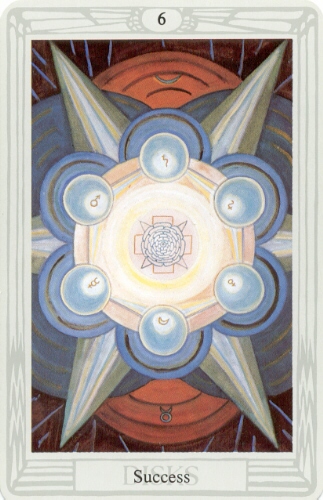
Thoth Tarot, Crowley-Harris
Today's card is the 6 of Stones, or 6 of Coins. We see six stones or boulders in a cave of some type. There is water on the cave floor, and a natural path leading to an opening that is filled with daylight. The six stones are arranged around this opening. Looking closer, the top three stones are in a triangle shape, and the bottom three stones are in an upside-down triangle shape. This has a distinct 'as above, so below' feel to it.  In the Thoth Tarot, the 6 of Disks has its pips arranged in a hexagram, too, from the centre of which glows the light of the rosy cross. So it is obvious here that Haindl has taken the original Thoth card and reinterpreted it in earthy imagery, rather than the stark, cold lines of the Crowley-Harris Thoth. It's more or less the same card, though.

image source
Rachel Pollack points out that the two triangles also form the top of the Tree of Life. The centre of the Tree of Life is sometimes called the Abyss, because there appears to be no sephira there. Actually there is, though it's often missing from diagrams or represented by a broken line: Daath. In the Six of Stones, the spot where Daath would be is represented by the glowing light of the cave door. The suggestion in the card, then,  is that the source of wisdom does not have to be separate from the material world. You can enjoy your earthly life and still achieve divine enlightenment. Or as Pollack puts it, 'We can find the true source of meaning within the happiness of daily life.'

In a reading, I would likely interpret this card to mean 'material success', just like it says on the tin, but would also see it as a reminder that success in life can be used to learn deeper lessons, even spiritual ones. The most important one probably being that the little moments of happiness in the day to day are the true keys to understanding our link to the divine. The pleasures of this world can be a gateway to divine connection, an idea which is clearly represented in this card image.


Monday, 23 July 2012

Wort Moon Reading -- Haindl Tarot

Haindl Celtic Cross (pardon my toe)


Wort Moon Reading using Haindl Tarot: Celtic Cross (Rachel Pollack's version from Haindl Tarot: Minor Arcana, 248-250). 

Sunday, 22 July 2012

Haindl Tarot: What's it all about?

'If suffering can have a creative meaning, Hermann Haindl's life and work were formed by it.'   ~ Erika Haindl
In my last post I mentioned I dislike Rachel Pollack's books about this deck. I should clarify by saying that in the past I've found them a bit frustrating, or did when I read them a few years ago upon buying my first Haindl Tarot deck. They seem as stream-of-consciousness as Haindl's paintings themselves, and that can be frustrating when you have come to a guidebook to make order of such complexity, only to find the explanations as abstract-random as the cards themselves. For me part of the problem is that each chapter starts with the Hebrew letters, runes, astrology, and/or I-Ching, and you have to skim past all this to get to the actual card images. For me this is a problem, as I do not like adding separate systems to tarot, and for me these are all unnecessary add-ons that get in my way! I have been dipping into them for the last couple of days and can say I still find them a little rambly--and think they could be offputting indeed to dewy-eyed tarot newbies--they are useful for gleaning insights into the artist's mindset and some of the curious elements of the cards.

If you're willing to plow through the detail and continuously remind yourself that these are Rachel Pollack's personal thoughts about these cards (sometimes with input from Haindl himself, but often just her own responses), the book can help with some of the more mysterious or curious elements on the cards, particularly with the majors. The books are not essential, though. When all is said and done, as deeply personal a tarot as this is, it is still a tarot, and if you bring to it Thoth/Golden Dawn interpretations (which can differ from contemporary RWS ones), it doesn't matter if you can interpret every single 'cosmic bubble' or cryptic reference to Wagner. It doesn't matter if you know Aleph from Tau, or what a tallis is.  You can still read with this deck.

And that's the important thing, because as Rachel Pollack points out in the introduction, the Haindl Tarot is not an occult deck, not in the sense of the Thoth et al. It is, as she points out, 'a sacred tarot, one which reaches back to ancient spiritual traditions and cultures...leading us to see the world as a vessel filled with spiritual power and truth' (Haindl Tarot: Major Arcana, New Page Books, 12).

Saturday, 21 July 2012

Haindl Tarot -- We're so tiny but we're all heading in the same direction

I've been playing around with loads of decks in the last few months (and not blogging about it, sorry!). Today for some reason, I decided to get out the Haindl Tarot. 

I have a complicated relationship with the Haindl. I guess a lot of us do. I really admire the deck, but I find I can't work with it much because for me the imagery is just so poignant. The cards are just throat-achingly rife with an emotion that I find hard to name. There is so much there. Decay, regret, the sense of an ending...but also beauty, a feeling of the eternal, and even glimmers of hope. But just glimmers.

I guess the thing that gets to me in this deck is the deep sense of how temporary humanity is, how fragile. How delicate we are in our emotions, our spirituality and our bodies. This is represented through the four suits and the court cards. Haindl uses Egyptian mythology in the suit of Swords, Native American in the suit of Stones (Coins), Western Europe in the suit of Cups, and Hindu gods and goddesses in the Wands. So in the courts, I see reflected the attempts of humanity to make sense of ourselves and our place in the universe and in relation to each other and our world.

Monday, 5 September 2011

I bought some herbs today, oh boy


I just bought these herbs and pots today. From left to right: peppermint, lemon thyme, oregano, rosemary, sage.

I'm a little worried because when I took the plants from their plastic containers to pot them, they had massive root systems that filled the entire container. I wasn't expecting that, but I'm no expert on plants by any means. So when I put them in the new clay pots, I had to add hardly any soil at all around them. Perhaps I should have bought bigger pots, but it's too late now. I can't very well unpot them all and exchange the pots. It's just like me to take something that was meant to be fun and relaxing and find ways to stress and fret over it. I don't want the plants to die because the pots are too small, they're not getting enough light, the window's too drafty. Etc.

The fact is, I've been way more stressed lately than I ought to be. I don't know if it's hormones, my work situation, worry about things back home in America, or general malaise caused by the upcoming equinox. I don't know what it is.

So I drew from the Haindl Tarot. What is going on today? What is the underlying cause? And what is a possible solution?